

By: Omar Rubio Alvarez
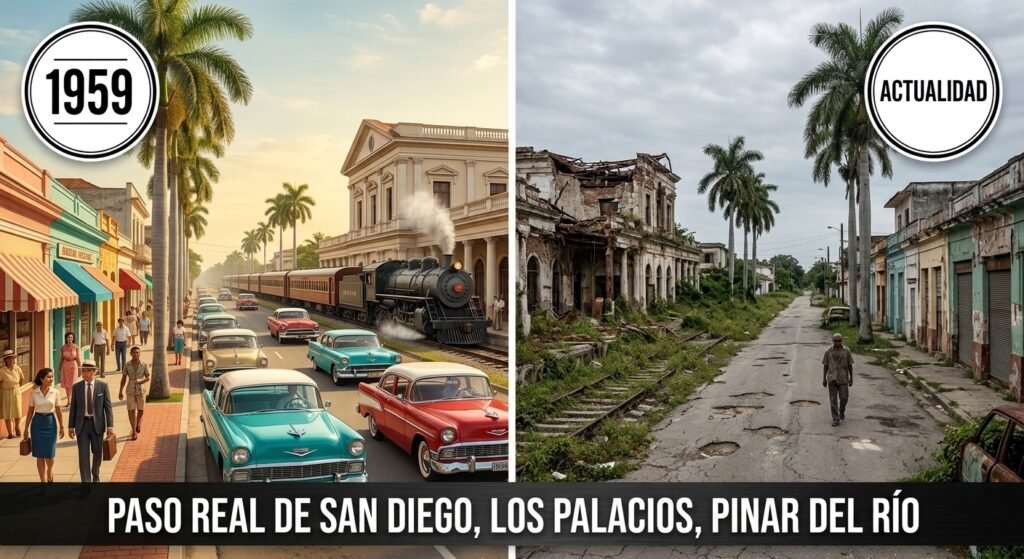
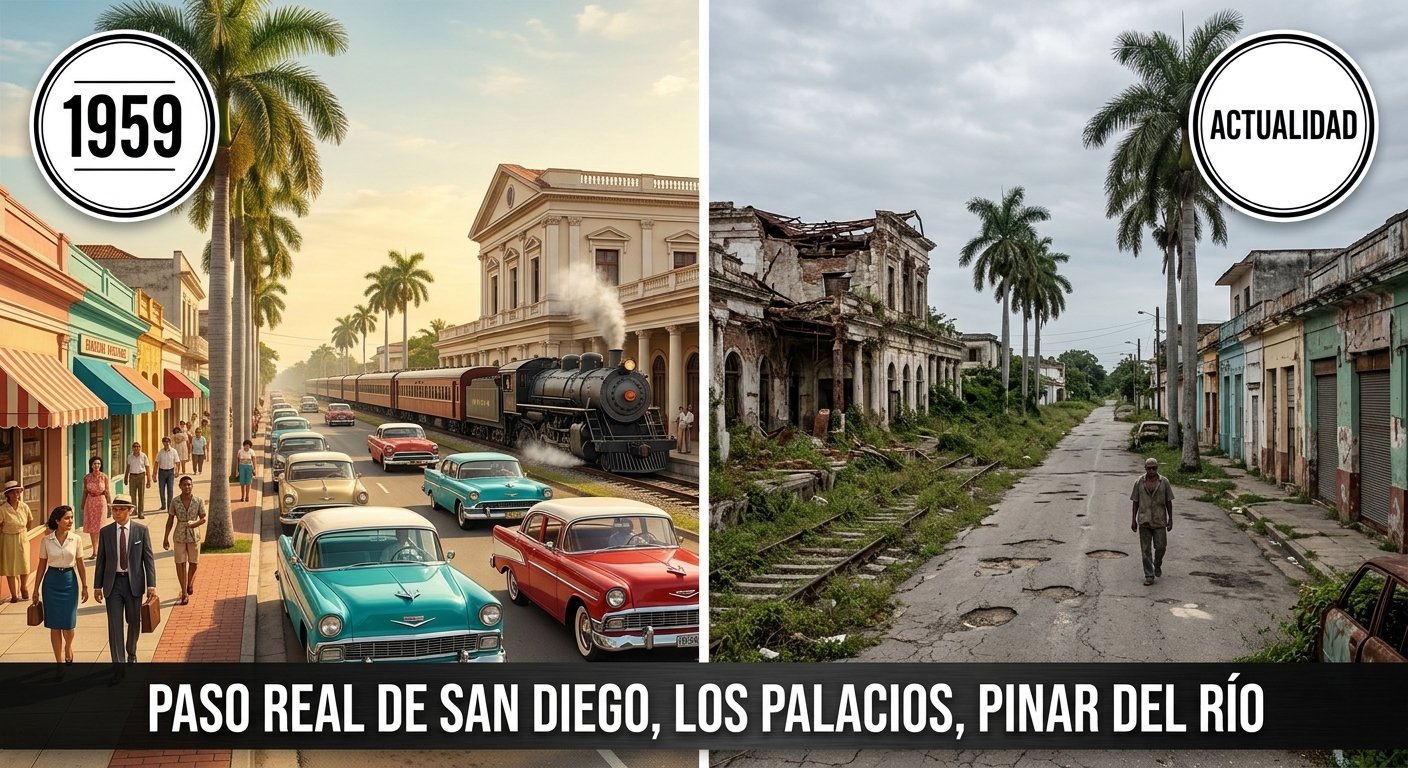
Local history holds treasures that allow us to measure the passage of time in our towns. Through the valuable testimony of literature graduate and professor Omar Rubio Álvarez, titled “Outline of the State of Commerce in Paso Real de San Diego in 1959”, alongside historical notes by Armando Ibáñez Hernández, it is possible to reconstruct the economic, social, and scientific dynamism of this community in the municipality of Los Palacios, Pinar del Río, and contrast it with the complex situation it faces today.
1959: A Prosperous and Vibrant Community
Around 1959, Paso Real de San Diego and its neighboring settlements, Santa Bárbara and Santa Mónica, had approximately 6,500 inhabitants. According to Rubio Álvarez, it was a town in constant motion, where New Year’s Eve celebrations brought neighbors together at recreational clubs to the rhythm of boleros and danzones, while the streets filled with the aroma of roast pork, hot tamales, and music playing from jukeboxes.
Entertainment was an essential part of daily life. The local movie theater screened international premieres every weekend, and the town frequently welcomed traveling shows and circuses such as Santo y Artigas, El Nelson, El Moreno, and Echazabal.
A Commercial, Agricultural, and Scientific Engine
The historical document details an economic infrastructure that stands in stark contrast to the region’s current landscape:
- Commercial Abundance: General stores (bodegas) like the well-remembered Máximo Rubio Martínez store offered a wide range of food, cured meats, canned goods, cheeses, olive oils, hardware supplies, and footwear.
- Agricultural and Industrial Production: The territory boasted 362 farms and large sugarcane, tobacco, and cattle estates, as well as a major rice and cotton company that employed over 600 permanent workers and around 250 seasonal employees, earning an average daily wage of 2.70 pesos.
- Tourism and Fishing Activity: On the southern coast, Dayaniguas beach welcomed hundreds of vacationers for three months each year, with about fifty vessels anchoring offshore filled with fresh fish and seafood that supplied establishments like the famous Fonda de Albolay.
- Comprehensive Service Network: The town featured 21 general stores, 7 eateries (fondas), 6 kiosks, 5 bars with jukeboxes, 5 butcher shops, 3 inns, 3 clothing stores, 2 hardware stores, 2 pharmacies, 2 variety stores (quincallas), 2 garages, 2 tobacco sorting houses, 2 modern barbershops, 2 recreational clubs, a bakery, a pastry shop, an ice cream parlor, a movie theater, a tailor shop, and a sugarcane juice stand (guarapera).
- Railway Connectivity: A fleet of 28 rental cars provided local transportation, while six daily trains (three from Pinar del Río and three from Havana) passed punctually through its station, making it the town’s primary social gathering spot.
- Meteorological Vanguard: According to Armando Ibáñez Hernández, on June 6, 1949, the most modern Weather Station of its era in the country was installed in Paso Real, equipped with technology donated by the United States Weather Bureau through the efforts of Dr. José Carlos Millás, director of Cuba’s National Observatory.
The Contrast with the Present: Deterioration, Scarcity, and Challenges to Official Narratives
Comparing that mid-20th-century snapshot with today’s reality reveals a striking contrast. The disappearance of the vast majority of those businesses, the halt of passenger rail traffic, and widespread shortages define daily life for the residents of Paso Real de San Diego.
The historical text itself already warned of this transformation, describing the abandoned state of the train station, collapsing homes, and the deterioration of streets and sidewalks. In those same pages, Enrique del Pino—former coordinator of the 26th of July Movement—lamented the town’s condition with blunt words: “What a shame and what sadness that station and that town give me today, despite the fact that the Revolution built the school center there, fixed a few streets, and made the park and three medical posts!”
In the debate over the causes of this decline, the Cuban government and its spokespeople maintain that material shortages and deteriorating services are the result of the prolonged impact of the U.S. economic embargo, a lack of external financing, and severe damage caused by extreme weather events in Pinar del Río, arguing that available resources have been prioritized to sustain social programs such as education and primary healthcare.
However, a large portion of the local population, independent economists, and critical voices flatly reject that official version and call it false, pointing out that government justifications serve as a pretext to cover up decades of mismanagement, state centralization, and administrative inefficiency. For these sectors, the loss of productive capacity, the energy crisis, and the neglect of rural communities like Paso Real de San Diego are the direct consequence of policies implemented after 1959 and a lack of political will to enact real structural reforms.
Beyond opposing viewpoints, Professor Omar Rubio Álvarez’s chronicle remains an indispensable record for understanding the magnitude of change experienced by Paso Real de San Diego: from being a vibrant agricultural, commercial, and railway hub in western Cuba, to becoming a reflection of the deep economic and social challenges facing the island today.